The Evening Ember

The making of Wick
Sudo make me a game
An AI wrote all 41,000 lines of code in Wick, my game about a little lantern, and I never read a single one. By the strict definition that is vibe coding, and it still took about 170 hours of my time.

One night, a gust of wind knocked a little lantern off his hook on the porch. His flame nearly went out, the house behind him went dark, and there he sat in the flower bed, all alone and trembling like mad. Then the clouds parted and the full moon came out.
She was the biggest, brightest lantern he had ever seen, and in her light his little flame found its courage again. So he decided, the way only a little lantern can, that he would climb all the way up to her.
That’s Wick. He is a tiny tin lantern with big, round, innocent eyes on his glass, and he never says a word. His eyes and his little flame do all the talking, and believe me, they talk a lot.
 clear
 apple red
 sunrise
 spark yellow
 leaf green
 harbour teal
 sky blue
 cobalt
 lavender
 rose pink
The flame is where the whole game lives. It is Wick’s courage, and it is also how far you can see. In the dark his courage drains away, the flame shrinks and the world shrinks with it, which of course makes the dark even scarier. Every candle in a window, every buzzing streetlamp and every friendly firefly fills him back up.
 Old Wax
 Buzz
 Blink
 the cat
 a moth
 a keepsake
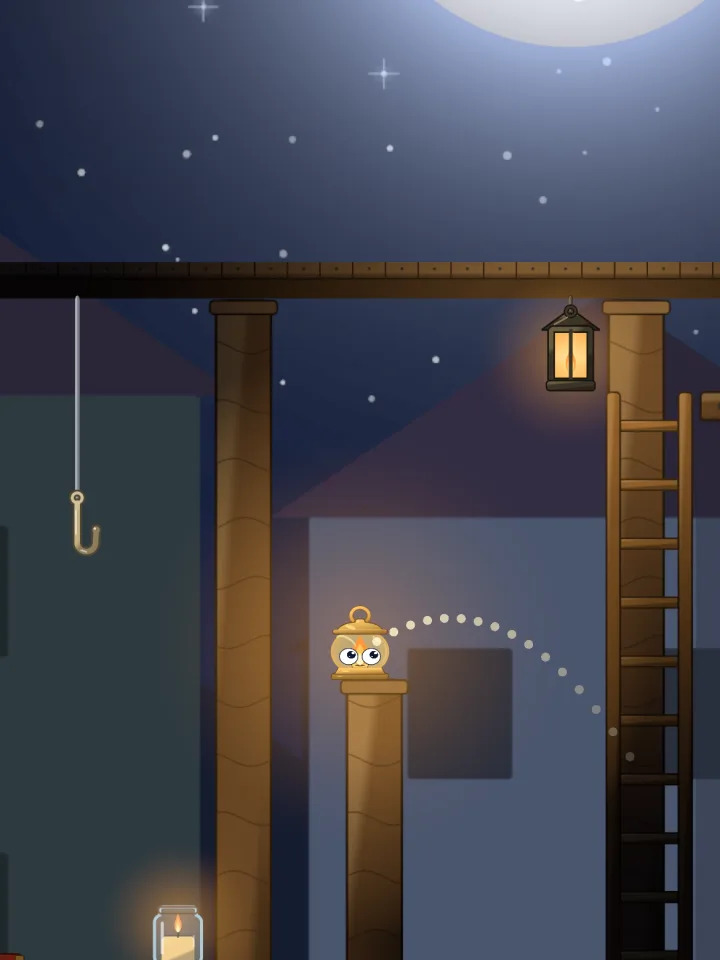
So the game is a run of short, brave dashes from one light to the next, played with one finger. Drag back from Wick and let go, and he hops like a little slingshot. Catch his handle on a hook, and he swings. And the whole seaside village around him is painted like a storybook at night.
All of it started with two random words. I asked Claude, the AI model I made the game with, for two words and got “lantern” and “gravel”. The lantern got the lead role. The gravel ended up as a wobbly garden path that tips Wick over if he hops carelessly, which isn’t a bad career for a heap of gravel.
Now, this could easily become yet another “I built a game with AI” post, and there are so many of those already. Before we begin I should of course confess that Claude wrote every line of Wick’s code and I never read any of it. It just wouldn’t be a post about AI without a confession like that, now would it? :)
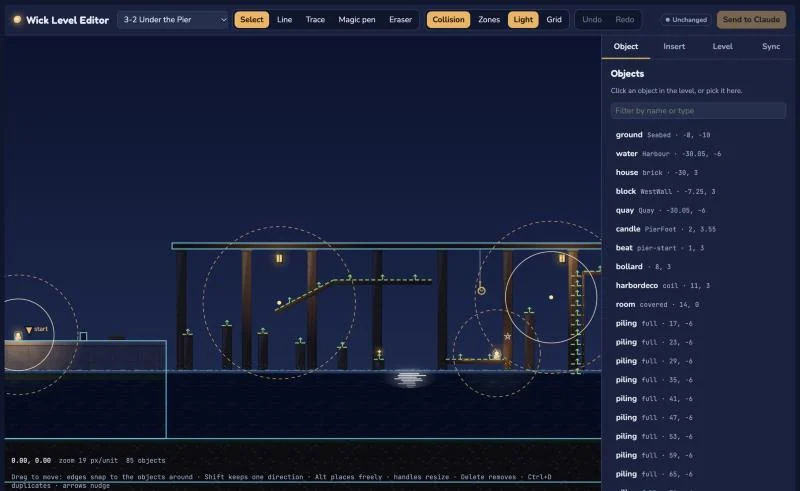
And yet I spent about 170 hours on Wick, and this post is about where those hours went. Keep one picture in mind while you read: Wick only sees as far as his own light reaches, and an AI only knows what is in its context. Everything outside that little circle is dark.
“Accept All”, they said…
In February 2025, Andrej Karpathy (a founding member of OpenAI and the former head of AI at Tesla) gave us a new term: vibe coding. You give in to the vibes and stop caring that there is code at all. You “Accept All” without reading a single change, and when an error message pops up, you paste it straight back in “with no comment”. Usually that fixes it. He called it “not too bad for throwaway weekend projects”.
The term has taken on a life of its own since then. Ask a developer what vibe coding looks like today, and I’m willing to bet you’ll hear something like this: somebody runs code they have never seen, pastes the error back in, accepts whatever comes out and repeats until the thing stops crashing. Somehow. With duct tape. What comes out the other end has a name too, and it isn’t a nice one: slop.
“I did not read any code at all. Not a single line.”
So here’s the honest part. Simon Willison, who writes a lot about building software with AI, pinned the definition down as “building software with an LLM without reviewing the code it writes” (an LLM, or large language model, is the kind of AI that Claude is). By that definition Wick is vibe coded, plain and simple, because I did not read any code at all. Not a single line.
Continued on the next sheet: Context first, then the sandwich